 


ABOUT CDMNET

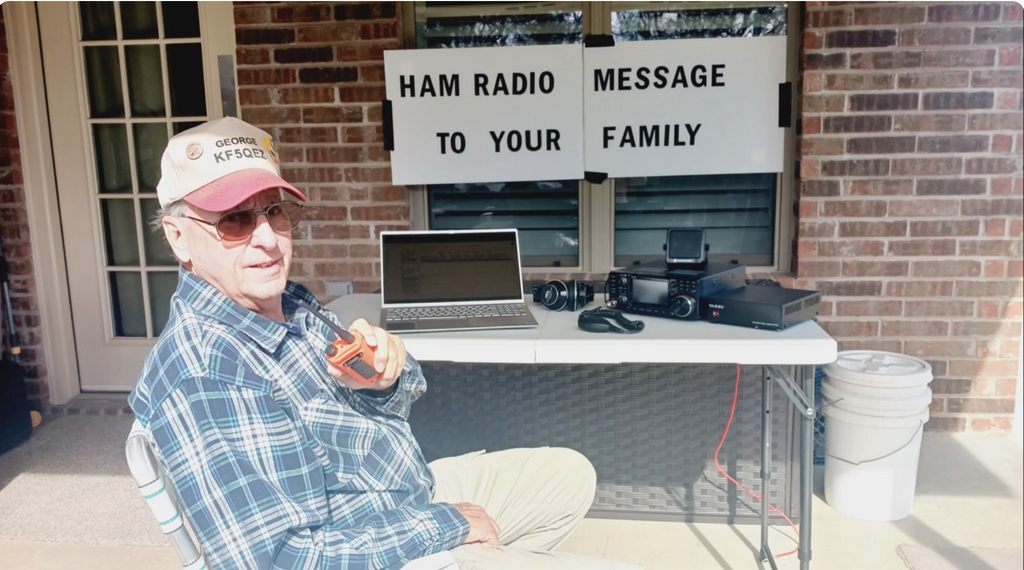
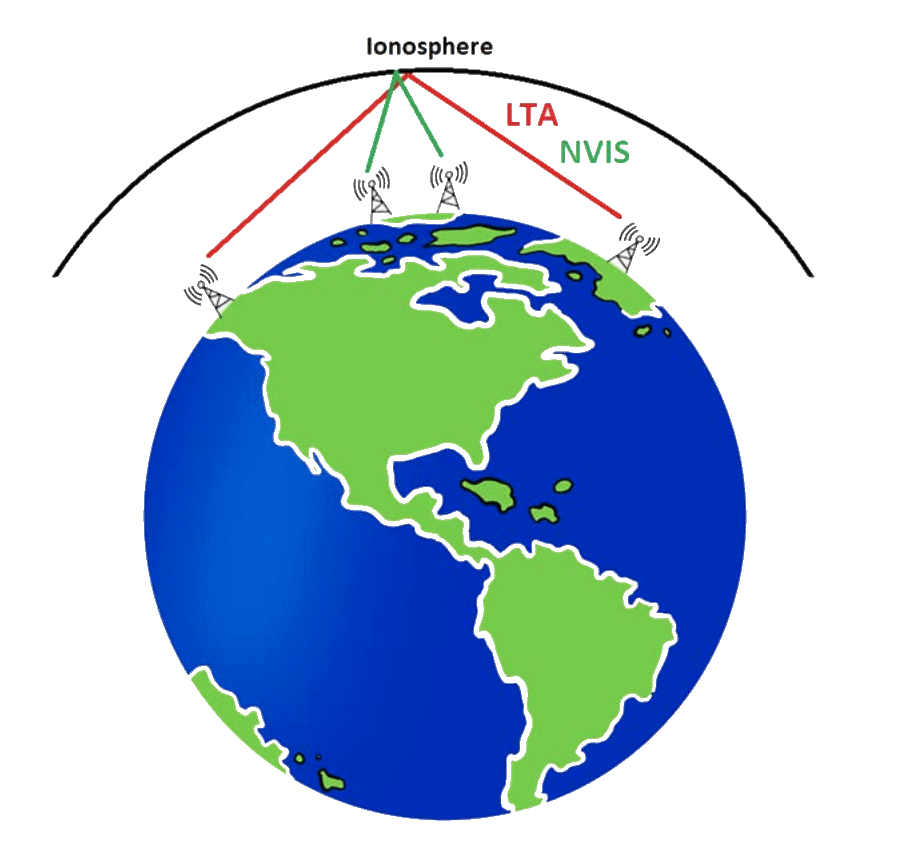
In the beginning, the North Texas NVIS Net was created in 2022 by George KF5QEZ to promote the use of NVIS antennas for use in reliable regional communications accessible from the north Texas area. The groups.io site (https://groups.io/g/North-Texas-NVIS-Net) and mailing list soon grew to over 100 members. Voice nets were set up to allow experimentation with NVIS antennas and testing out equipment on 40 meters on First Sundays and Third Saturdays each month. The Youtube channel @NTXNVIS-Channel https://www.youtube.com/@NTXNVIS-Channel was created to host training materials for the NTXNVIS group.
 
 The NTXNVIS digital group was formed as a subgroup of the North Texas NVIS Net by Austin N4AKL, Tom N5DOM, and Mark K5CCC to promote use of digital modes for emergency communciation when poor band conditions made SSB voice communications unusable. Practice sessions were scheduled following the SSB Voice net to promote and practice using digital modes including JS8Call, FLDigi, VarAC, and Winlink.


 The Community Disaster Messenger (CDM) concept was originally defined as another sub-group from the North Texas NVIS Net led by George KF5QEZ to promote organizing groups and clubs to support welfare messaging during an emergency.
 
 This web site was created as a home for the Community Disaster Messenger to promote the concept and host training content for all aspects of CDM.  Please contact us at:

 community.disaster.messenger@gmail.com

for further details.


HOW DOES THE SYSTEM WORK?

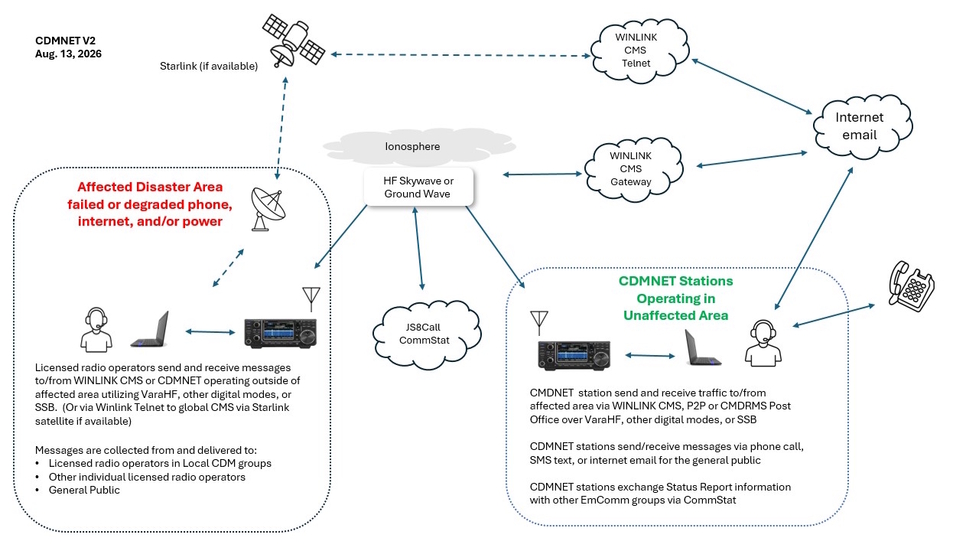
CDMNET is designed as a resilient amateur radio network supporting appropriately licensed, individual Community Disaster Messengers and other emergency communication groups in their ability to pass emergency welfare traffic for the public.


This is best accomplished by providing a robust training program, practice nets and exercises focusing on the use of Winlink for public welfare messaging, JS8Call for group communications and CommStat for situational awareness. 


Non-internet and radio-only alternatives are also an integral part of the system to ensure reliability and resiliency as shown on the flowchart below. 


OUR TRAINING AND FILES

PRIMARY MODES

CDMNET uses these primary modes of operation:

           -  WINLINK

        -  JS8CALL

        -  FLDIGI

        -  COMMSTAT


         SECONDARY MODES USED ARE:

         -  VarAC

         -  SSB Voice


Files and Links


North-Texas-NVIS-Net


JS8Call User's Guide


FLDigi Digital Net Tips


Digital Setups For Popular Radios


Winlink Vara HF Peer-to-Peer (P2P) Ops de ND1J


ARRL Amateur Radio Bands Chart


Q-Signals


ARRL Radiogram Training thru 7290 Traffic Net


ARRL Radiogram Form


Portable Operations Checklist


____________________________


The viewer acknowledges and agrees that any use of the information and/or the software linked on this website to make voice or data transmissions on the amateur radio bands in the United States requires the appropriate license to have been previously issued to the control operator of the transmitting station by the Federal Communications Commission in Washington, DC.


    TRAINING VIDEOS


SCHEDULED NETS

NET OPERATIONS

All scheduled nets are previously announced on the Groups.io webpage and will take place year-round at 15:00 in the Central Time Zone following the conclusion of the North Texas NVIS Voice Net. 


Those participating in the voice net will be given a reminder about the upcoming digital net. Any appropriately licensed amateur radio operator is invited and encouraged to participate.


The scheduled nets are directed nets under the supervision of an NCS (Net Control Station). Follow the instructions of the NCS for the mode in use at the time. Emergency traffic has priority and may break-in and transmit at any time.


Once the net begins, participants are asked to follow the instructions of the NCS and not transmit until told to do so by the NCS.  


FLDigi check-ins will use the following format and procedure:


Callsign (twice) / Name / County / State / TFC with precedence or No TFC.


Precedence labels:

RR = Routine

PP = Priority (very important and transmitted before Routine)

II = Immediate (needs the most expeditious handling to destination possible)


Example: 1 RR means one piece of routine traffic for the net.

KXXXX KXXXX / Name / County / State / 1 RR


A destination other than the net can also be added for a specific callsign, tactical callsign or group.


Example: / 2 PP WXXXX would mean two pieces of priority traffic for callsign WXXXX.

KXXXX KXXXX / Name / County / State / 2 PP WXXXX


Once NCS transmits the preamble and establishes an ANCS station, they will call for check-ins with and without traffic and any relays of stations with or without traffic. The designated ANCS station will also call for check-ins at the direction of ANCS.


Once all stations have checked-in and been acknowledged, NCS will instruct all stations holding traffic to pass their traffic to the net.


On conclusion of any traffic, NCS will list all stations acknowledged so far and call for any additional late check-ins, questions, comments or training requests. When hearing nothing further, NCS will close the net. 


However, any station requesting additional training may remain on frequency after the net to receive additional training in any area they desire.


JS8Call Check-in-Only Net Procedure


  • JS8Call nets will use the standard 40M frequency, 7.078MHz
  • Each station should enable @CDMNET in your call groups
  • Temporarily remove any other groups that may participate in
  • Turn off Heartbeat ACK (to limit extra traffic on the pass band)
  • Enable Auto Reply (so you will respond to messages to the group)
  • Find an open section of the waterfall and adjust as needed to avoid other traffic
  • Net Control will send an announcement to start. Please hold off on sending direct messages or MSG to the group until after all check-in's are collected.
  • NC will send an SNR? message to look for check-ins
  • NC will acknowledge check-in's. When you see your check-in acknowledged, turn off Auto Reply.
  • NC will repeat SNR? and acknowledgement until all are collected.
  • NC will ask for relays for missed check-ins, report final check-in list, give any announcements, and close net to return to regular use of frequency.


You may re-enable Auto Reply and send messagesIf you have traffic you can save a "Stored Message" directed to the NC callsign with any traffic or test message.  You can do this at anytime, not just during a scheduled net.


After close of check-in net, NC will poll the group for messages with QUERY MSGS to the @CDMNET group, and pick up messages from each station.
NET SCHEDULE 


SCHEDULED NETS

TIME

(year-round)

MODE

FREQUENCY

NCS


FIRST SUNDAY OF EACH MONTH


15:00 in the  CENTRAL

TIME

ZONE


FLDIGI

(CONTESTIA 4/250)

(TxID Off)


 7.120 MHz centered at

1500 Hz on the Waterfall


W5TTA


THIRD SATURDAY OF EACH MONTH


15:00 in the CENTRAL TIME ZONE


VARIOUS EVENTS TBA ON GROUPS.IO PAGE


VARIES


N5DOM


ALERTS / NOTICES


NONE


Contact Us